
The IRAP assessment boundary is the set of system components, people, processes and technologies that will be assessed. It is defined under IRAP and agreed with the assessed entity before substantive work begins. A tight, well defined boundary keeps the control count and the cost down. A broad one inflates both.
The assessment boundary for an IRAP assessment is the set of all system components, people, processes, and technologies to be evaluated as part of the assessment. It is defined under IRAP and agreed with the assessed entity’s delegate authority before substantive assessment work begins. The boundary must cover every applicable environment, document what is excluded and why, address data sovereignty and shared responsibility, and distinguish between what is being assessed and what the authorising officer will ultimately choose to authorise. Getting the boundary wrong at the start creates gaps that cannot be recovered cleanly at the reporting stage.
Why is the IRAP assessment boundary usually wider than expected?
The scope written down before the first working session is almost always narrower than the boundary finally agreed. A common starting list covers the production environment, the application layer, and the database that stores the classified data. The boundary review then pulls in components that list left out.
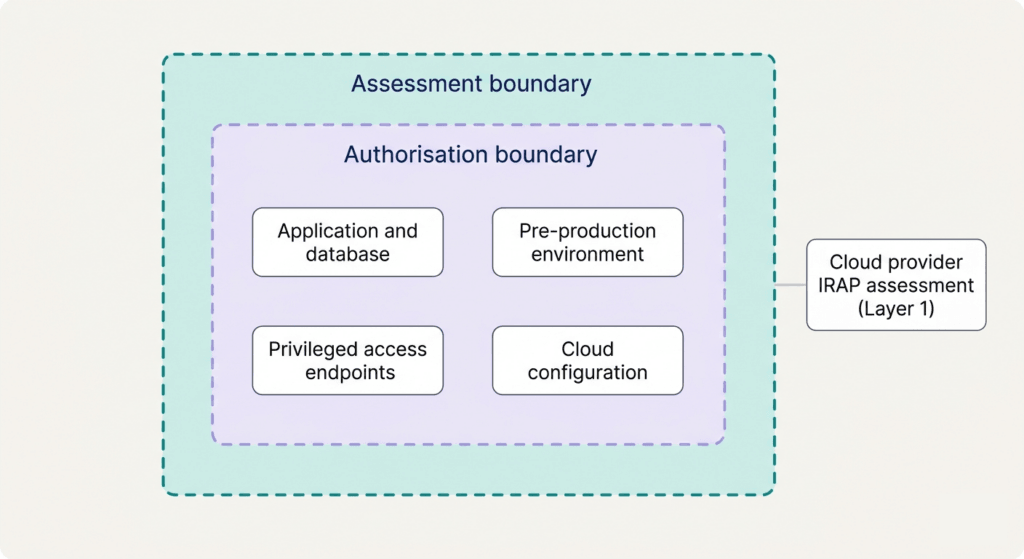
Pre-production is the first. If a non customer facing environment holds any real data for testing, it belongs in the candidate scope, not outside it.
Identity management is the second. A third party identity service that is already IRAP assessed by its provider does not fall out of scope. The provider’s assessment covers the provider’s responsibilities. The configuration of that service, and the access controls applied and maintained on top of it, is still in scope.
Privileged access is the third. If administrators reach the system through a jump server, the devices they use to connect matter. Corporate laptops used for privileged access must be addressed within the boundary where they have not been assessed separately, because a jump server does not contain the risk that comes from the underlying endpoint.
Work through these before committing to a scope, and the agreed boundary will be larger than the initial list. Not unmanageable, but wider.
What is the difference between the IRAP assessment boundary and the authorisation boundary?
These two terms are often used interchangeably by organisations preparing for IRAP. They are not the same.
The assessment boundary is everything the IRAP assessor will evaluate. It includes all system components and associated assessment objects: specifications, mechanisms, and activities.
The authorisation boundary is what the authorising officer chooses to authorise for operation within their organisation. It may match the assessment boundary exactly, or it may be a subset. An authorising officer might assess three services and choose to authorise two. What the authorisation boundary cannot do is exceed the assessment boundary. Nothing can be authorised that has not been assessed.
Who defines the IRAP assessment boundary, and who agrees it?
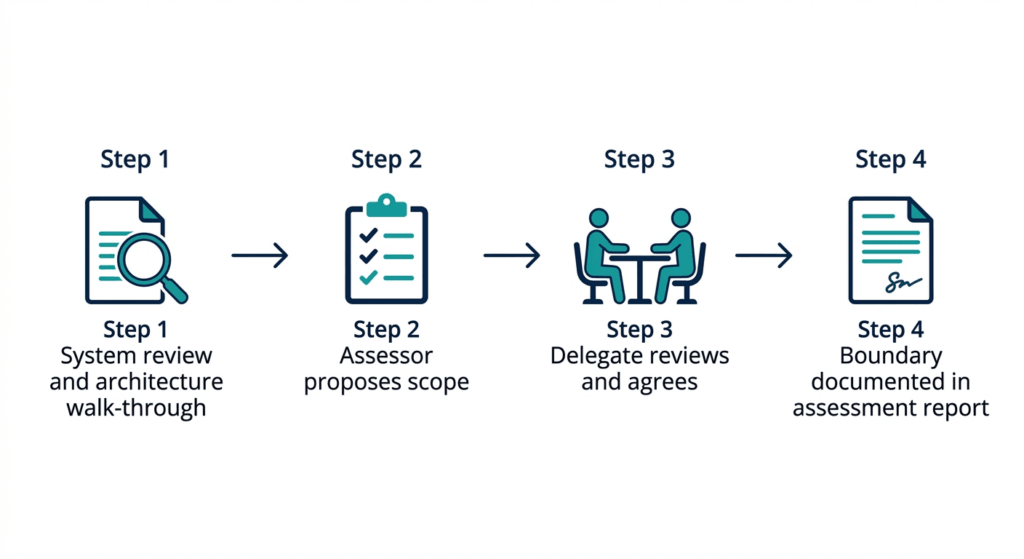
The boundary is defined under IRAP and agreed by the assessed entity’s delegate authority.
This is not the organisation presenting a scope and having it rubber-stamped. The assessed entity may have a view, and that view is a useful starting point. IRAP assessors validate whether that view is appropriate. If it is too narrow, they must say so and document the reasoning.
The boundary can also change. As the assessment progresses and new information emerges, the boundary may need to be revisited with the delegate to confirm what has been included and excluded. This is expected and is not a sign that preparation was inadequate.
What do IRAP assessors consider when defining scope?
The IRAP Common Assessment Framework (CAF) identifies several dimensions to work through when determining what belongs inside the boundary.
| Scope dimension | What is checked | How it is treated |
|---|---|---|
| Environments | Production, pre production, test and development | Included, or excluded with documented justification; a non production environment holding real data is brought in |
| Data classification | The classification the system will store, process or communicate | Sets the applicable ISM control set and thresholds |
| People, processes, technologies, facilities | Operators and administrators, the processes they follow, relevant physical facilities | In scope where applicable, not only servers and software |
| End user computing devices | The devices administrators use for privileged access | In scope if not separately assessed; a jump server does not remove endpoint risk |
| Third party providers and shared responsibility | The shared responsibility split with a cloud or SaaS provider | Provider controls referenced through their IRAP assessment; consumer configuration, access and integration stay in scope |
| Data sovereignty and offshore elements | Whether data or metadata is processed, stored or accessed outside Australia, including offshore admin staff | Documented, with the applicable ISM controls addressed |
- Environments: Production is the starting point but not the end point. Pre-production, test, and development environments each carry their own risk profile. If a non-production environment holds real data, or if its configuration materially affects the production system’s security posture, it warrants inclusion or explicit exclusion with justification.
- Data classification: The intended classification of the data the system will store, process, or communicate determines the applicable ISM control set. A system handling OFFICIAL: Sensitive data draws a different control set and threshold from one handling PROTECTED. The classification identifies which controls apply and at what threshold.
- People, processes, technologies, and facilities: The boundary is not limited to servers and software. It includes the people who operate and administer the system and the processes they follow. Physical facilities relevant to system security are also in scope where applicable.
- End user computing devices: Where administrators connect to the system via privileged access, the devices they use are part of the security chain. A jump server provides some protection but does not eliminate the exposure created by a compromised endpoint. If those devices are not separately assessed, they fall inside this boundary.
- Third-party providers and shared responsibility: Where the system relies on services from a cloud or SaaS provider, the shared responsibility model is mapped out. Controls the provider is responsible for are addressed through the provider’s IRAP assessment, referenced in the consumer’s own. Controls that fall to the consumer, including configuration, access management, and integration security, remain in scope for this assessment.
- Data sovereignty and offshore elements: The assessment report must address whether any data, including metadata, is processed, stored, or accessed outside Australia. This includes offshore staff with administrative access. Where these elements exist, they must be documented and the applicable ISM controls addressed.
How does layering IRAP assessments reduce the controls a consumer is responsible for?
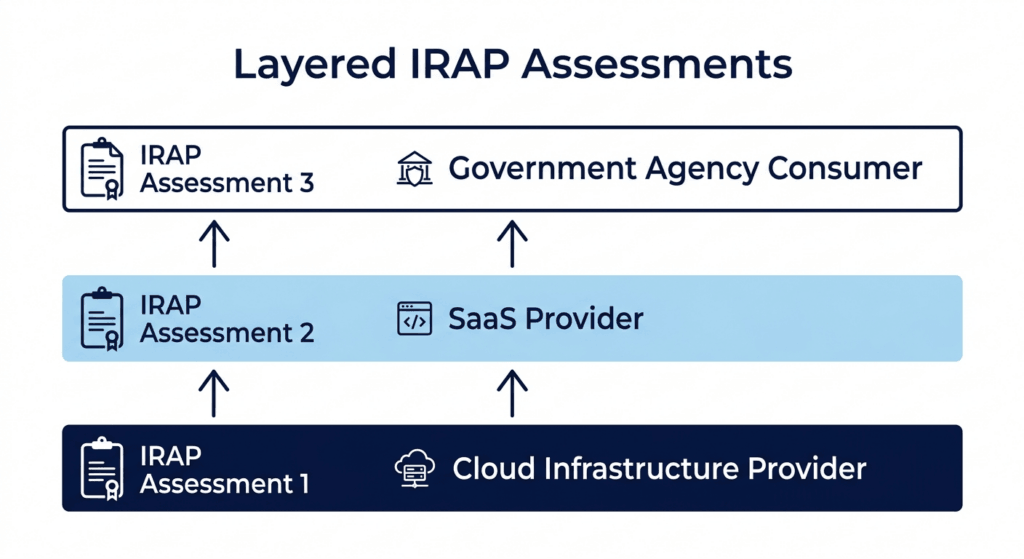
Where a system runs on a cloud infrastructure platform that holds an existing IRAP assessment, and uses an identity provider that also has a current IRAP assessment report, those prior assessments are relevant but they do not reduce the consumer’s own scope to zero.
IRAP assessments can be layered. The cloud provider’s assessment covers the infrastructure layer and the provider’s responsibilities. A SaaS provider assessment, where one exists, covers the service layer. The consumer’s own assessment covers its responsibilities: how the system is configured, how access is managed, how data is handled, and how the controls that fall in its part of the shared responsibility model are implemented.
The prior IRAP reports for the cloud and identity providers are reviewed, the relevant findings noted, and what can be relied on and what cannot is documented. That reference work then sets the scope of the consumer’s own control matrix.
How are IRAP boundary inclusions and exclusions documented?
A well-defined boundary requires both. Including something without explaining why it is in scope and excluding something without explaining why it is out of scope are both quality failures.
Every exclusion carries a documented justification in the assessment report. A development environment that contains no real data and is isolated from production with no shared credentials can be excluded on those grounds. A corporate network segment used only for internal business functions unrelated to the assessed system can be excluded with an explanation of the segmentation controls in place. Each exclusion goes into the report so the authorising officer has a complete picture.
The discipline is useful in itself. It forces precision about what is being claimed out of scope and why. Reviewing the justification will sometimes lead to a decision to bring a component back in rather than try to defend the exclusion.
What does an agreed IRAP assessment boundary set up?
By the end of Stage 2 there is a documented, agreed IRAP assessment boundary. A typical one covers the production environment, the pre-production environment where production data is present, the privileged access workstations, the configuration of the cloud platform and identity provider, and the relevant people and processes, with the development environment excluded on documented justification.
That agreed IRAP assessment boundary becomes the reference point for every subsequent stage of the assessment. Control applicability, evidence gathering, sampling decisions, and the structure of the final report all follow from it.
The next step is to collate the required documents and evidence for the assessment. We cover that in How to Prepare for an IRAP Assessment.
Related reading: what information classification means for IRAP, how to prepare for an IRAP assessment, and the complete IRAP assessment guide. For help scoping and defining a boundary before assessment, see Cybernion’s IRAP readiness service.
Frequently asked questions
What is an IRAP assessment boundary?
The assessment boundary is all components of an information system to be evaluated as part of an IRAP assessment, including related specifications, mechanisms, and activities. It is defined under IRAP and agreed with the assessed entity’s delegate authority before assessment work begins.
How is the IRAP assessment boundary different from the authorisation boundary?
The assessment boundary is what is evaluated under IRAP. The authorisation boundary is what the authorising officer chooses to authorise for operation. The authorisation boundary may be equal to or smaller than the assessment boundary but cannot be larger. An organisation cannot authorise a system component that has not been assessed.
Can the IRAP assessment boundary change during the assessment?
Yes. The boundary may evolve as a more complete understanding of the system emerges. The boundary is regularly reviewed and validated with the assessed entity’s delegate throughout the assessment process.
Does an existing IRAP assessment of our cloud provider reduce our scope?
It reduces the scope of controls the consumer is responsible for demonstrating, not the scope of the assessment itself. The provider’s assessment covers their responsibilities. The consumer-layer assessment covers how services have been configured and implemented, how access is managed, and the controls that fall on the consumer’s side of the shared responsibility model.
What happens if something is excluded from the IRAP assessment boundary?
Exclusions must be documented with clear justification in the assessment report. A component cannot simply be omitted without explanation. The rationale for the exclusion must be recorded so the authorising officer can make an informed risk decision about whether they accept that boundary.
Written by Gaurav Vikash, an ASD endorsed IRAP assessor and senior cyber security leader with 18 years of experience across Australia, the UK and Asia, including CISO and senior security leadership roles. He holds CISSP, CISA, CISM and CRISC and is an ISO 27001 Lead Auditor and ISO 42001 Lead Implementer, and speaks regularly at industry conferences.
Talk to us. We aren’t always chasing a transaction.
Sources:
- ASD IRAP Consumer Guide, July 2025
- IRAP Common Assessment Framework, April 2025
- Australian Government security classifications and PSPF requirement 0109, PSPF 2025
Last updated: 21 June, 2026