
IRAP
IRAP Readiness Checklist: How to Prepare for an IRAP Assessment
21 June 2026 · Updated 7 Nov 2026
IRAP readiness is the work done before the assessment begins, and this checklist covers it: confirm the classification and boundary, write the system documentation, and map evidence to each applicable ISM control. There is no pass mark to chase. Readiness exists to close the gaps the assessment would otherwise record as findings.
What does IRAP readiness actually involve?
An IRAP assessment is an independent, point in time review of a system against the Information Security Manual (ISM), run under IRAP by ASD endorsed assessors. Readiness is everything done to be ready for that review. It is not the assessment, and it is not a certification to pass. The assessor checks each applicable ISM control, records its implementation status, and writes that into the report and control matrix the authorising officer reads. Anything not documented or evidenced becomes a gap in writing.
Readiness is the cheapest money spent on IRAP, because an assessment that cannot reach documentation, cannot get system accounts provisioned, or cannot get the right people on a call will record those gaps as constraints. In practice, the organisations that skip readiness do not fail, since there is nothing to fail. They extend the timeline and give IRAP assessors a longer list of constraints, and that does not help the authorising officer form a positive view of the system. Preparing properly is the organisation’s own responsibility, and the ASD IRAP Consumer Guide includes a baseline preparation checklist to work from.
What goes on the IRAP readiness checklist?
Readiness breaks into seven areas: classification and scope, documentation, control implementation, evidence, people and access, the timeline, and a pre assessment review. We work them in that order, because each one depends on the one before it. The complete IRAP guide sets the wider context, while the table below is the working list.
| Area | What to confirm before the assessment starts |
|---|---|
| Classification and scope | The classification of the data is set by the agency that owns it and confirmed in writing. The assessment boundary is drawn and agreed |
| Documentation | System Security Plan and SSP annex, Security Risk Management Plan, continuous monitoring plan, incident response plan, system design documents and current security policies, all written, approved and current |
| Control implementation | Each applicable ISM control implemented, or a decision recorded where it is not, with the residual risk owned by a named person |
| Evidence | Dated, system specific evidence mapped to each control that reflects ongoing practice, not a policy that says the control should exist |
| People and access | System administrators, security staff and system owners scheduled for interviews, with system access, facility access and clearance verification arranged |
| Timeline | Start date, end date and any milestones tied to the authorisation deadline, agreed in advance |
| Pre assessment review | A dry run against the ISM that finds the gaps while they can still be fixed, rather than the assessment finding them first |
How do we scope the system and confirm the classification for IRAP?
Two decisions set the size of the whole assessment: the classification being assessed to, and where the boundary falls. If either is wrong, everything downstream inflates. The classification of the information is set by the agency that owns the data, not the provider, so we confirm it in writing before scoping and never assume PROTECTED because a customer mentioned it. The ISM control set is the same at OFFICIAL: Sensitive and PROTECTED. What changes are the physical security, personnel clearance and network obligations, and SECRET adds further requirements again.
The assessment boundary is the set of systems, people, processes and technologies in scope. A tight boundary keeps the control count and the cost down, while a broad one inflates both. Draw it deliberately, exclude what falls outside, and document the interfaces where data crosses it. Agreeing the boundary gives a clear picture of what will be evaluated, but it is a separate question from whether the organisation is ready for the assessment to begin.
Which documents do we need before an IRAP assessment?
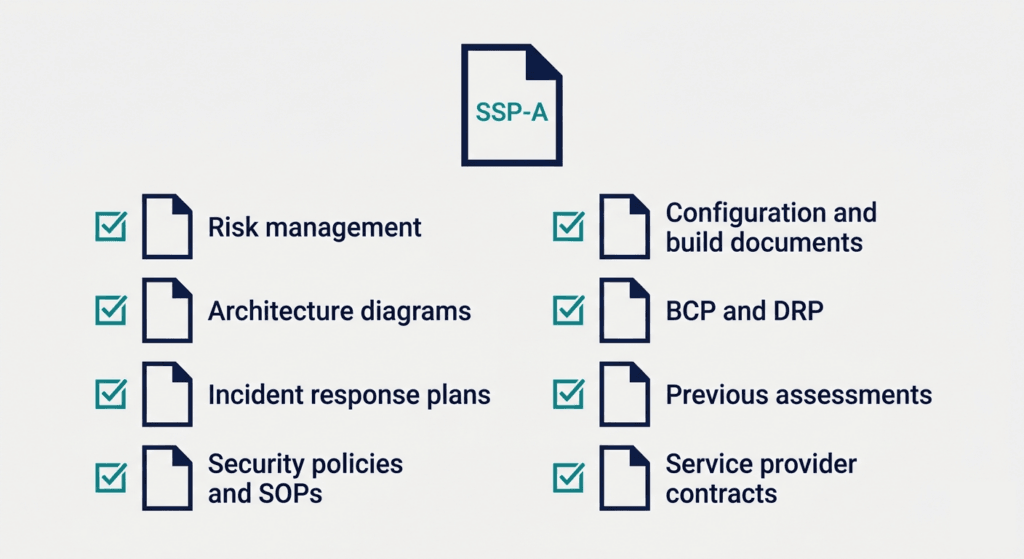
The assessor works from the documentation first, so thin documents are the most common reason a timeline slips. The core set is the System Security Plan and its annex, the Security Risk Management Plan, a continuous monitoring plan, an incident response plan, system design and architecture documents, and the security policies that govern the system. The SSP annex matters most. The control matrix produced under the assessment is a derivative of it, so if the annex is incomplete or out of date IRAP assessors rebuild it with the team, and that is time on the clock.
Beyond that core, the ASD preparation checklist points to a supporting set that should be ready before the start date:
- Risk management documents, including any existing risk register or risk treatment plan for the system
- Logical and physical diagrams of the system environment
- Incident response playbooks relevant to the system
- Standard operating procedures covering the system
- Configuration and build documents, including the hardening guidelines applied
- Business continuity and disaster recovery plans
- Previous security assessment reports or penetration test results
- Service provider security contract extracts where third parties deliver or maintain the system
These documents do not need to be perfect, but they need to be accurate, approved by the relevant authority and reflective of what is actually implemented, because only what is implemented can be assessed, not what is planned. Write them as living documents that match what the system does, not aspirational policy. An assessor can usually tell the difference in the first interview.
How do we gather evidence IRAP assessors will accept?
Documentation describes what should be in place, while evidence demonstrates that it is, so a policy that says a control exists is not evidence the control works. For each applicable ISM control the assessment must see the control operating: a screenshot of the multi factor configuration or the cryptographic settings, an export of patch status, vulnerability scan results, a sample of access logs, a change record, a backup restoration test result, a record of an access review. Where a control is delivered through an automated mechanism, the assessment will want the configuration export or tool output, not the document that describes the intent.
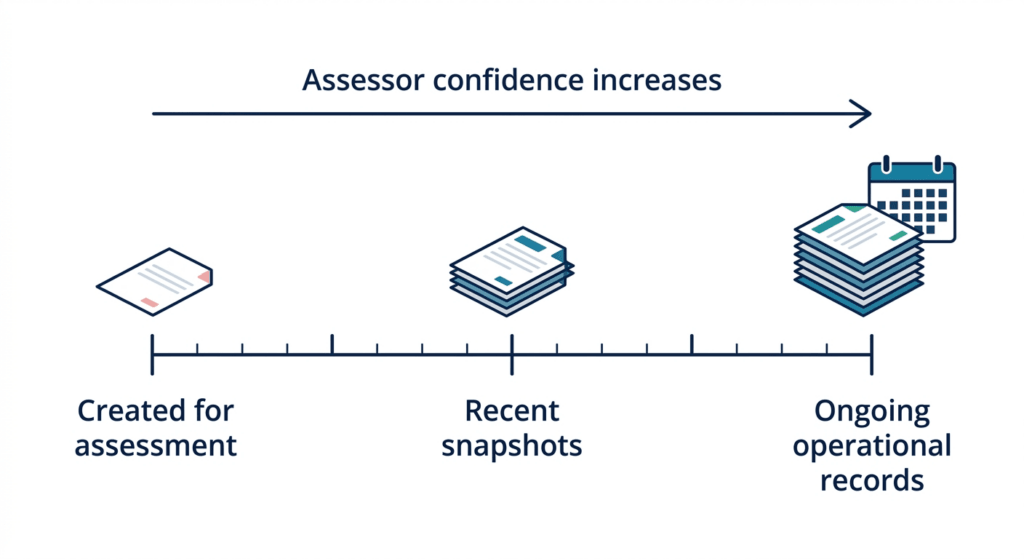
Quality matters as much as coverage. Evidence gathered in the days before an assessment, or created specifically for it, is weaker than evidence that reflects ongoing operational practice, and IRAP assessors are trained to tell the two apart. Months of patching records give a much stronger basis for rating a control effective than a single current snapshot.
Map one clear artefact to each control before the assessment starts, dated and labelled. Where a control is not implemented, do not hide it. Record the decision and who owns the residual risk, because honest gaps are easier for IRAP assessors to work with than evidence that does not match what the system does. The fastest assessments we see are the ones where the evidence is already mapped and the time is spent confirming, not chasing.
Who needs to be available during an IRAP assessment, and what access is needed?
An IRAP assessment speaks with people as well as reading documents, so system administrators, security staff and system owners should be scheduled and available for the assessment period. Interviews are a core part of evidence gathering, and if key people are unavailable, controls that depend on demonstrating a human process cannot be fully assessed. Those gaps are documented as constraints in the report, and the authorising officer reads them.
Access logistics deserve the same attention. The assessment needs system access appropriate to its scope, facility access where on premises components are involved, and clearance verification where the classification requires it. Clearances in particular take time, so they belong at the front of readiness rather than the week before. Sorting all of this ahead of time avoids delays at the start, which otherwise compress the time left for the assessment work itself.
How long does IRAP readiness take, and when should we start?
We allow six to eight weeks for readiness on a moderately complex system, and start it before booking the assessment, not after. There is no fixed duration published by ASD. The IRAP Common Assessment Framework defines the stages, not the weeks, and the real driver is how mature the documentation and evidence already are. Our indicative figure is six to eight weeks of readiness ahead of an assessment that itself runs around 12 to 16 weeks for a moderately complex system. Treat both as indicative, not a quote.
The assessment timeline itself should be agreed before work begins: the start date, the expected end date, and any milestones tied to the organisation’s own authorisation deadlines. How long it runs depends on complexity, scope size, the availability of evidence and familiarity with the environment, and well prepared organisations consistently finish faster. For a cloud provider, build the cadence in. Under PSPF requirement 0109 the system must have been IRAP assessed within the previous 24 months against the latest ISM, so readiness is recurring work, not a one off.
What does good IRAP preparation look like in the final weeks?
Good preparation is done through the checklist in the weeks before the start date, not the days. In practice that means reviewing the SSP annex against every configuration change made since it was last touched, redrawing the architecture diagrams to match the agreed boundary, pulling patching records from the patch management platform, and briefing system administrators on the assessment window so they hold their availability. Done well, the assessment begins on the agreed date, with access in place and a documentation package that matches the system as it was actually built.
Preparation does not guarantee a clean report, and it does not lower the standard. What it does is give the assessment the best starting point, so the report reflects the organisation’s actual security posture rather than the gaps in its evidence collection. Cybernion runs IRAP readiness for organisations preparing for assessment, from the gap analysis against the ISM through to a pre assessment readiness review. Next: how the IRAP assessment process works.
Frequently asked questions
Is IRAP readiness the same as an IRAP assessment?
No. Readiness is the preparation done beforehand: documentation, control implementation and evidence. The assessment is the independent review against the ISM under IRAP. Readiness is not assessed and carries no pass mark.
Do we need an IRAP assessor to run IRAP readiness?
No. Readiness can be done in house or with an advisor, and it does not have to be the firm that later assesses the system. An assessor must stay independent of the system they assess, so using the same firm for deep remediation and the assessment creates a conflict to manage.
What classification should we prepare for in IRAP readiness?
The one the agency that owns the data sets, confirmed in writing. The ISM control set is the same at OFFICIAL: Sensitive and PROTECTED. The physical, personnel and network obligations differ, and SECRET adds more again.
What is the most important document to have ready for an IRAP assessment?
The System Security Plan and its annex. It is used to understand the system, its components and how controls are implemented, and the control matrix is derived from it. If it does not exist or is out of date, it needs to be written or updated before the assessment starts.
Does our evidence need to be perfect before an IRAP assessment begins?
No, but it needs to be accurate and reflect what is actually implemented. Historical evidence is more valuable than evidence created for the assessment, and IRAP assessors are trained to tell ongoing operational records apart from documentation produced for the occasion.
What happens if key people are unavailable during an IRAP assessment?
Controls that depend on demonstrating human processes cannot be fully assessed without the relevant people. Gaps in evidence availability are documented as constraints in the report, and those constraints form part of what the authorising officer reviews.
Can we reuse IRAP readiness work for the next assessment?
Yes, if it is maintained. Cloud providers must be reassessed within 24 months under PSPF requirement 0109, so keeping documentation and evidence current between assessments turns the next readiness into an update, not a rebuild.
Written by Gaurav Vikash, an ASD endorsed IRAP assessor and senior cyber security leader with 18 years of experience across Australia, the UK and Asia, including CISO and senior security leadership roles. He holds CISSP, CISA, CISM and CRISC and is an ISO 27001 Lead Auditor and ISO 42001 Lead Implementer, and speaks regularly at industry conferences.
Talk to us. We aren’t always chasing a transaction.
Sources:
- Infosec Registered Assessors Program (IRAP), ASD, accessed June 2026
- ASD IRAP Consumer Guide, July 2025
- Information Security Manual, ASD, June 2026
- IRAP Common Assessment Framework, ASD, April 2025
- Protective Security Policy Framework, requirements 0086 and 0109, accessed June 2026
Last updated: 7 November, 2026