
An IRAP assessment is an independent, point in time assessment of a specific system against the Information Security Manual (ISM), performed by ASD endorsed IRAP assessors. It produces a report and a control matrix. It is not a certification, an accreditation, or an authorisation to operate, and there is no pass mark.
An IRAP assessment is an independent, evidence based evaluation of a specific system’s security controls, conducted by ASD endorsed IRAP assessors against the current version of the Information Security Manual (ISM). It produces two documents: the IRAP Security Assessment Report and the Controls Matrix. It does not produce a certificate, an accreditation, or an authorisation to operate. The assessment evaluates what is implemented and reports on findings and recommendations. The decision to authorise the system rests with the system authoriser, not with IRAP assessors.
What is an IRAP assessment?
An IRAP assessment is an independent security assessment of a specific system, conducted by ASD endorsed IRAP assessors, that evaluates whether the security controls implemented in the system are operating effectively against the intent of the relevant controls in the Information Security Manual. The ISM is published and updated by ASD every quarter.
The assessment is conducted for a specific system handling classified information, not for the organisation operating or managing it. The organisation as a company is not assessed; the specific platform that stores and processes the agency’s classified data is what is assessed. Different systems within the same organisation handling classified information at different classification levels may each need their own separate assessment.
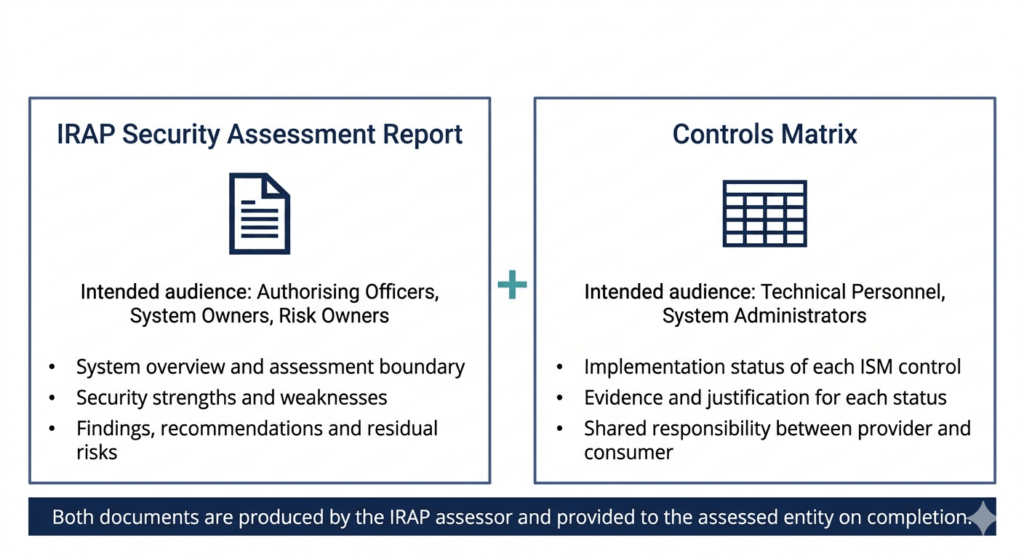
The main deliverables of an IRAP assessment are two documents. The first is the IRAP Security Assessment Report, or the IRAP Cloud Security Assessment Report for cloud services. This is intended to be read by authorising officers, system owners, and risk owners. The second is the Controls Matrix or Cloud Controls Matrix, which is intended to be read by technical personnel and system administrators responsible for integrating the assessed system into their organisation. Both documents are produced under the assessment and provided to the assessed entity on completion.
For TOP SECRET systems, only ASD conducts the assessment.
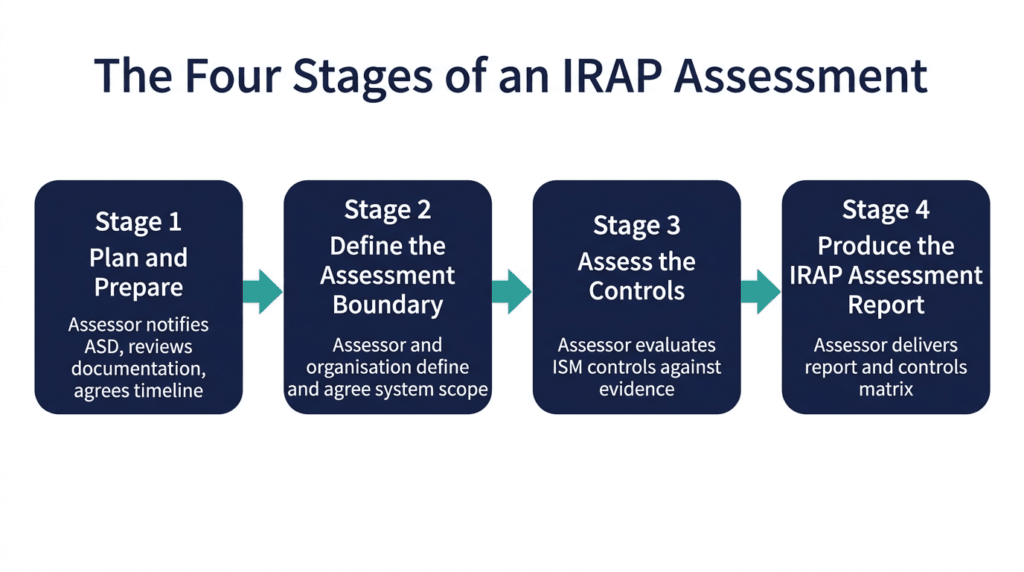
Which ISM version applies to an IRAP assessment?
IRAP assessors must use the latest version of the ISM available at the time the assessment begins. If a new version is released during the assessment, the IRAP assessors and the organisation may agree to switch to it. An assessment must not fall more than one version behind the current ISM. If two ISM releases occur during the assessment, the assessment must switch to the latest version. ASD publishes the ISM quarterly, typically in March, June, September, and December.
What is an IRAP assessment not?
- It is not a certification. There is no IRAP certificate, there is only an IRAP assessment leading to an IRAP report, and there is no pass mark. A system does not become IRAP certified. The assessment produces a point in time report against the latest version of the ISM. Some vendors use the phrase “IRAP certified” in their marketing. That phrase has no formal meaning under the framework and its use is not permitted under ASD’s brand and marketing guidelines.
- It is not an ongoing accreditation. The assessment reflects the state of the system at the time it was conducted. If the system changes materially afterward, the report may no longer accurately represent its security posture. Cloud service providers and managed service providers are required to undergo reassessment at least every 24 months.
- It does not guarantee authorisation to operate. A completed assessment does not mean the system has been approved to handle classified information. The system authoriser reviews the report, considers the residual risks, and makes that decision independently. Agencies have declined to authorise systems that have completed IRAP assessments.
- It is not a one size fits all exercise. The scope, depth, and applicable ISM controls vary depending on the classification of information the system handles and the nature of the system itself.
- IRAP assessors do not accredit, certify, endorse, or register systems on behalf of ASD, the assessed entity, or the consuming agency. They also do not provide a recommendation on whether a system should be authorised to operate. That decision rests with the system authoriser.
If an IRAP assessment is not a certification, who approves the system?
The authorising officer inside the consuming agency approves the system. Under the Protective Security Policy Framework (PSPF), requirement 0086, the authorising officer weighs the residual risks in the IRAP report against the agency’s risk appetite and makes a risk based decision to operate. The IRAP assessment informs that decision but does not make it. This is the line we see providers get wrong most often, because an assessment in hand is not approval to process government data. Agencies have declined to operate systems that completed an IRAP assessment, since the residual risk was theirs to accept and they chose not to. What goes to the officer is covered in the IRAP authorisation package.
Why does the IRAP certified label persist?
The label persists because ASD once did certify. Until 2020 the program operated a certification model, and the habit outlived the practice. ASD ceased certifying and moved to the current model, where the assessment reports and the agency authorises. Vendors and tender writers still reach for “IRAP certified” because it sounds definitive, but the term has been wrong for years, and anyone who offers to certify a system under IRAP is describing something that no longer exists.
What is the difference between a certification and an IRAP assessment?
A certification ends in a certificate issued by a certifying body, while an IRAP assessment ends in a report that an agency uses to make its own decision. The table sets the two side by side.
| Aspect | A certification | An IRAP assessment |
|---|---|---|
| Outcome | A certificate and a pass result | A report and a control matrix, no pass mark |
| Who decides | The certifying body | The agency’s authorising officer (PSPF 0086) |
| What it covers | Conformance to a standard | A specific system against the ISM at a set classification |
| Validity | A fixed certificate term | Point in time, reassess within 24 months for cloud providers (PSPF 0109) |
| The role | Grants or withholds the certificate | Reports strengths, weaknesses and residual risks, does not approve |
Who can conduct an IRAP assessment?
IRAP assessors are cyber security professionals endorsed by ASD. To become an IRAP assessor, an individual must be an Australian citizen, hold at minimum a Negative Vetting Level 1 security clearance issued by the Australian Government Security Vetting Agency (AGSVA), hold recognised qualifications across two categories covering certifications such as CISSP, CISM, CISA, and CRISC, and have a minimum of five years of experience in information security roles using Australian security frameworks including the ISM and PSPF.
They must also complete ASD’s IRAP training course and pass all assessment components, with a minimum exam pass mark of 80 percent.
IRAP assessors are not employees or contractors of ASD. They are independent professionals who have met ASD’s endorsement requirements. ASD maintains a register of current IRAP assessors on cyber.gov.au.
What is the IRAP conflict of interest requirement?
Before commencing an assessment, IRAP assessors must submit a Conflict of Interest declaration to ASD at least seven business days before the assessment begins. An IRAP assessor cannot have contributed to the design, implementation, or documentation of the system being assessed. This includes drafting system documentation, conducting gap assessments, providing design recommendations, or having a material interest in the system. IRAP assessors who are permanent employees of an organisation cannot conduct IRAP assessments for that organisation regardless of their level of involvement in the design of the system.
If a conflict of interest arises during the assessment, the declaration must be updated immediately. In the case of a real conflict, work must stop until ASD has reviewed the declaration and any proposed mitigations.
How is a completed IRAP assessment correctly described?
ASD is explicit on the approved terminology for marketing a completed assessment. The correct framing is: “Organisation X has completed an IRAP assessment for System X against the Information Security Manual’s classification level controls.” Stating or implying that a system is IRAP certified, IRAP approved, or authorised by ASD or the Australian Government is not accurate and not permitted. The specific services or system assessed must also be clearly identified.
What should an agency ask for instead of IRAP certification?
The useful things to ask for are the IRAP assessment, the classification and the date. The right question is not whether a provider is IRAP certified, but whether this system has had an IRAP assessment, at what classification, and when. Currency matters, because under PSPF requirement 0109 a cloud service provider must have had an IRAP assessment within the previous 24 months against the latest ISM at the time of assessment. Ask to see the assessment report and the control matrix, check that the classification matches the data, and check the date. A current report at the right classification is worth far more than the word certified. Providers preparing for their first assessment usually start with an IRAP readiness review, and those ready to be assessed can talk to us about an IRAP assessment.
Frequently Asked Questions
Can a company be IRAP certified?
No. There is no IRAP certificate or pass mark. A company can have a system that has completed an IRAP assessment against the ISM at a given classification. IRAP certified is industry shorthand that the program itself does not support.
Did IRAP ever involve certification?
Yes. Until 2020 ASD operated a certification model. It ceased that practice and moved to the current model, where IRAP assessors report and the consuming agency’s authorising officer decides whether to operate the system.
What does an IRAP assessment produce?
Two documents: the IRAP Security Assessment Report, intended for authorising officers and risk owners, and the Controls Matrix or Cloud Controls Matrix, intended for technical personnel responsible for integrating the assessed system. Both are produced under the assessment and provided to the assessed entity on completion.
Does completing an IRAP assessment mean our system is approved to handle government data?
No. A completed assessment gives the system authoriser the information needed to make an authorisation decision. Agencies have declined to authorise systems that have completed IRAP assessments. The assessment does not guarantee, imply, or substitute for authorisation.
Can our IRAP assessor recommend whether our system should be authorised?
No. IRAP assessors report on findings and make recommendations to improve security posture. They do not rate risks on behalf of the assessed entity or government agency, and they do not make a recommendation on whether the system should be authorised. That decision rests entirely with the system authoriser.
Which ISM version applies to our IRAP assessment?
The latest version available at the time the assessment begins. If a new version is released mid-assessment, the IRAP assessors and the organisation may agree to switch. If two ISM releases occur during the assessment, the assessment must switch to the latest version and conduct a delta assessment against it.
What disqualifies someone from acting as our IRAP assessor?
An IRAP assessor cannot have contributed to the design, implementation, or documentation of the system being assessed. This includes gap assessments, design recommendations, and drafting system documentation. Permanent employees of an organisation cannot assess that organisation’s own systems. Corporate affiliations, material financial interests, and personal relationships that could influence the assessment must also be declared. If any conflict arises during the assessment, the declaration must be updated immediately and work may need to stop until ASD has reviewed it.
Related reading: whether an IRAP assessment is needed to sell to government, the IRAP report and control matrix, and the complete IRAP assessment guide.
Written by Gaurav Vikash, an ASD endorsed IRAP assessor and senior cyber security leader with 18 years of experience across Australia, the UK and Asia, including CISO and senior security leadership roles. He holds CISSP, CISA, CISM and CRISC and is an ISO 27001 Lead Auditor and ISO 42001 Lead Implementer, and speaks regularly at industry conferences.
Talk to us. We aren’t always chasing a transaction.
Sources:
- ASD IRAP Consumer Guide, cyber.gov.au, July 2025
- IRAP Common Assessment Framework, cyber.gov.au, April 2025
- IRAP Policy and Procedures, cyber.gov.au, June 2026
- Information Security Manual, Australian Signals Directorate, June 2026
- Protective Security Policy Framework, requirements 0086 and 0109, accessed June 2026
Last updated: 7 November, 2026